It is not often that someone comes along who is a master of their craft and a transformative teacher. The Andy Franz: Legacy Exhibition at the Anne Reid ’72 Gallery presents the late Andy Franz, a woodworker and beloved Princeton Day School teacher, as both.
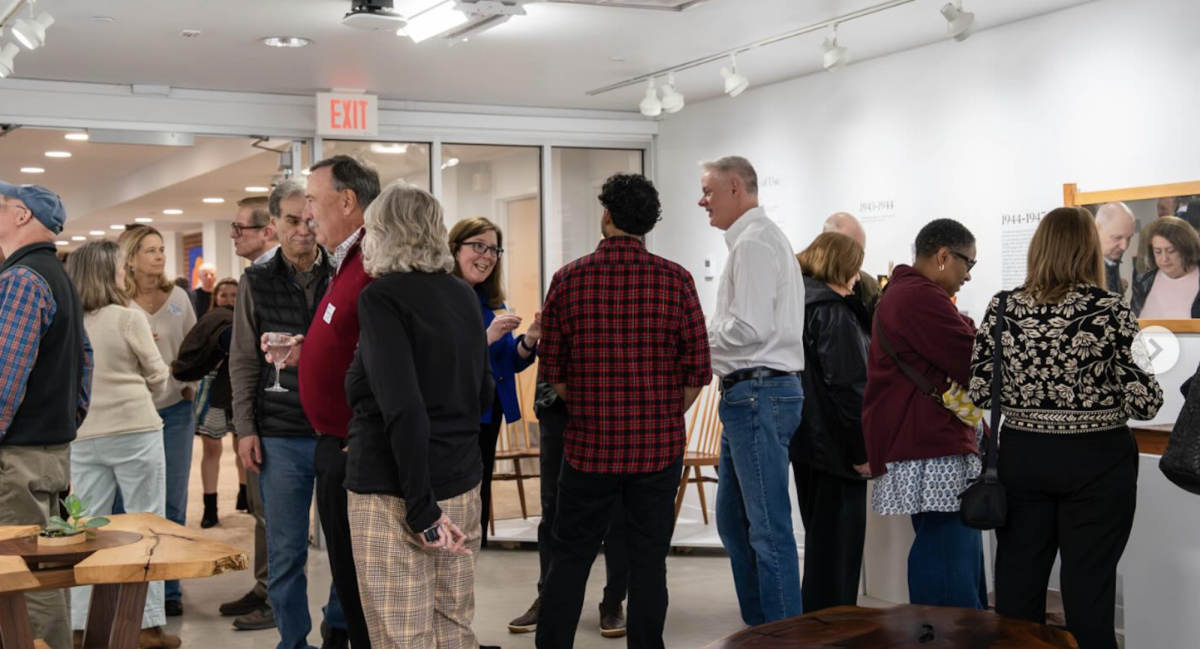
The exhibition unfurls with a conch shell lamp, gently lighting the way toward a quiet yet resilient narrative. This tone is further echoed in the inscription of Marge Piercy’s poem “To Be of Use,” selected at the suggestion of Mr. Franz’s daughter, Susi, who felt its message had resonated with her father’s lifelong dedication to creating objects that were useful and meaningful. Lamps, chairs, and tables of various shapes and sizes fill the space, reinforcing this emphasis on functionality and craftsmanship. Snippets of dialogue run along the gallery walls, reflecting key moments in Mr. Franz’s life: from surviving the Holocaust as a child, to working for acclaimed woodworker George Nakashima, to teaching at PDS for nearly three decades.
Co-curator and Fine Arts Teacher Ms. Gwen Shockey explained that the guiding idea for this installation was rooted in Mr. Franz’s dedication as a teacher, recounting how he “set a really top notch bar for a legacy of furniture making at PDS.” Echoing this sentiment, co-curator and Furniture Design teacher Mr. Christopher Maher shared, “I just wanted to pay homage to the decades and decades of work that he [Mr. Franz] had done here.” These traces of remembrance extend into the tangible spaces of the school: Mr. Franz’s name is inscribed on a plaque outside the door of the woodshop, and the senior award for furniture design is named after him. Ms. Shockey recalled that even after his retirement in 1998, “he would come every year to present the award to the senior who won it.” Together, these elements speak to Mr. Franz’s visible influence at PDS, but perhaps an even greater legacy lies in the quieter, more intangible moments he shared with his students, and the lasting impact he left on them.
To truly highlight Mr. Franz’s close bond with his students and, naturally, the effect he had on them even years after graduation, Ms. Shockey and Mr. Maher gathered pieces from former senior award recipients to showcase alongside Mr. Franz’s own works. Ms. Shockey noted that some of the student pieces, like Jesse Hollander’s ’24 chair, were not made under Mr. Franz’s direct instruction, but that “the whole program is so inspired by Andy, the legacy carries forward.”
Even so, the most striking aspect of the exhibition is the vast collection of emails, testimonies, and handwritten notes hung on the walls, left by past students over the years. One student reflected on how Mr. Franz shifted his initially skeptical view of woodworking through his selfless and nurturing approach as a teacher. Another remembered that, with Mr. Franz’s guidance, he not only learned the technical aspects in woodworking, but also gained experience in paying attention to detail and collaborating with others.
While the exhibition is very much grounded in Mr. Franz’s legacy, the placement of a mirror at the beginning of the showcase invites the viewer to see themselves inside his legacy. As the viewer approaches the large rectangular mirror, they first encounter their own reflection. Yet, when they take a small step back, the background of the emails and handwritten notes, coupled with some photographs, come into view. The reflection in the glass transforms it into a work of its own, creating a moment of continuity where the viewer is visually positioned between the past and present.
In this way, Mr. Franz’s work, alongside student pieces and memories, forms a stronger and more meaningful impact. Held together by joinery, wood glue, and shared experiences, these elements converge into a cohesive narrative, driving the story forward.