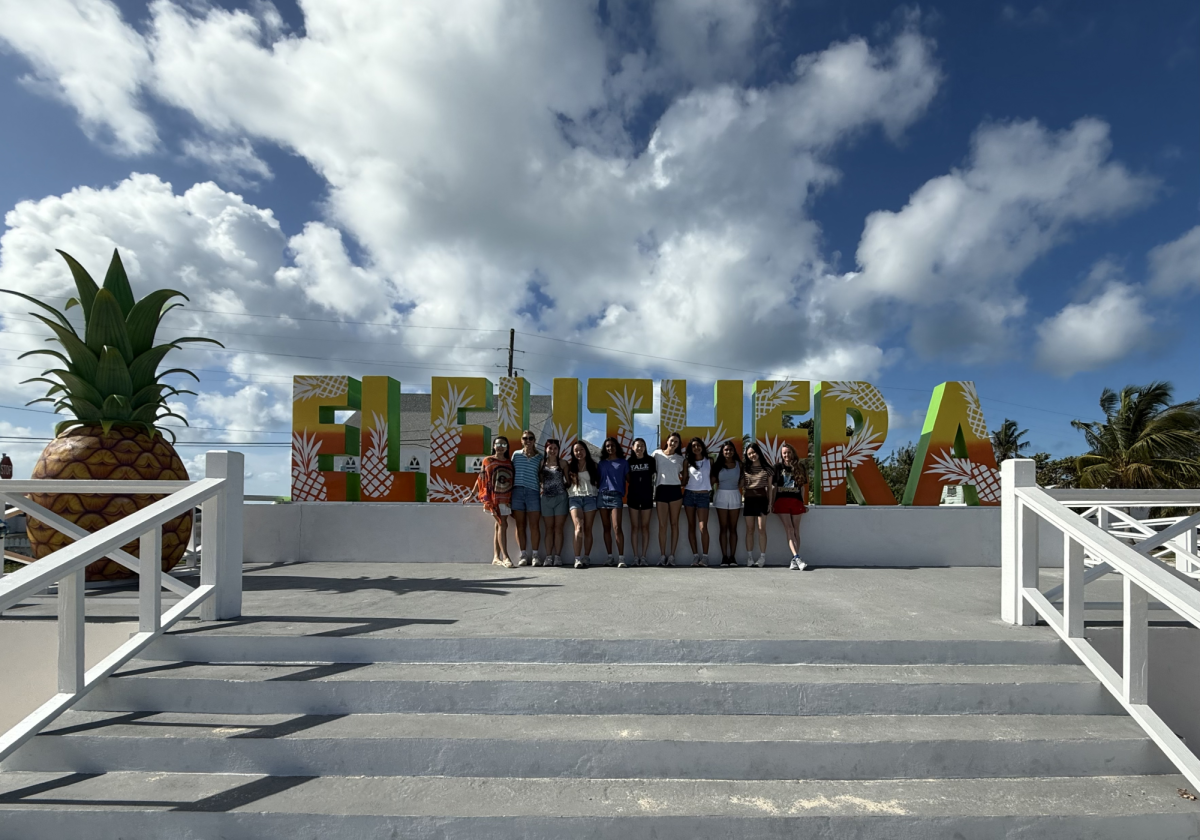
Over spring break, a group of Upper School students traded their classrooms for the clear blue waters, beautiful beaches, and vibrant sunrises of the Island School in Eleuthera, Bahamas. For one week, students were completely disconnected from their devices and immersed themselves in a hands-on world of marine biology and sustainability.
Organizing this trip was a hectic process, according to trip coordinator Señora Chity-Guevara. She noted that planning starts in the previous year, and while stressful at times, is ultimately rewarding. The trip consisted of a schedule packed with activities, such as watching the sunrise every morning, snorkeling in the coral reefs, and conducting research based off of new discoveries, providing students with a cohesive learning experience and an opportunity to explore newfound passions and perspectives regarding marine biology and sustainability. “I hope students leave this experience not only feeling inspired to adopt more sustainable practices in their daily lives, but also having built lasting friendships with the other people in their cohort,” Señora Chity-Guevara remarked.
The Island’s School’s unique approach of teaching through hands-on experience combined with research was a highlight of the trip for students. “I really loved how on the whole trip, we did fun activities but also combined them with basic research,” explained Sophomore Arundhati Prabhu. “It honestly didn’t feel like work at all even though I was gaining so much knowledge.” One of her favorite parts of the trip was going snorkeling and observing the beautiful coral reefs and limefish. Later, she performed a dissection, gaining a deeper understanding of marine life and the surrounding ecosystem. Experiences like these show how the Island School is “one with its environment” and remains environmentally conscious to ensure no harm to the life surrounding it.
In addition to gaining academic knowledge, students felt that the trip helped them grow as people. Sophomore Sophie Shin mentioned that the lack of her phone for a week was a refreshing change, allowing her to notice the smaller details in nature that she would otherwise overlook, such as the softness of the sand or the sound of the breeze. Prabhu seconded this and further elaborated on this point. She explained that adapting to a new environment—consistently waking up at six in the morning, adjusting to a packed schedule, and sharing spaces—allowed her to step out of her comfort zone. With it, her initial discomfort quickly vanished because she was “having too much fun.”
A common theme most students appreciated while on the trip was the strong sense of community on the island. “Everyone says hello to each other and even on the roads of Eleuthera, some of the cars honk at us in a playful way,” Shin shared, admitting that she had never been in this type of environment before. Although she did not know many people before the trip, she explained how working toward common goals and living together helped create bonds that a traditional classroom could not.
Overall, the Island School trip proved that education is most impactful when it is experienced directly rather than behind a desk. From swimming with sharks to experiencing the simplicity of life without devices, these students returned to PDS with a deeper understanding of the natural world and a reminder of the importance of stepping outside comfort zones.