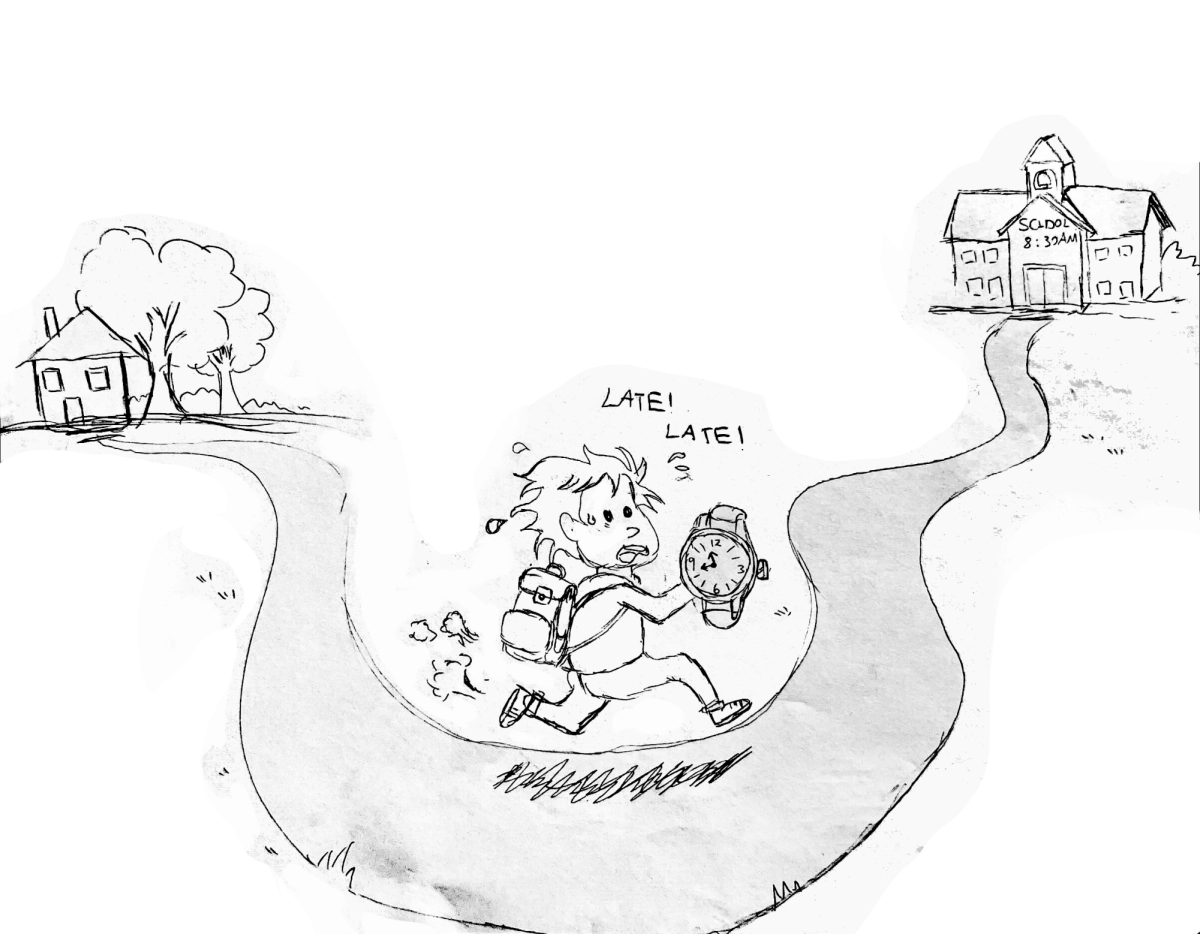
The sun is barely up. Your alarm rings, you drag yourself out of bed, and your head still feels half asleep. There is barely time for breakfast before you rush out the door, hoping a quick chat with friends will wake you up before the first period. For many Upper School students, this is not laziness: it is because we are fighting against our own biology. Teenagers are wired to stay up later and wake up later. That is why I strongly believe that the Upper School should start later.
Scientific research backs this up. The American Academy of Sleep Medicine explains that during adolescence, our brains release melatonin—the chemical that helps us fall asleep—much later at night than adults. That means even if we get into bed early, our brains simply aren’t ready to sleep. When the alarm rings at 6:30 a.m., we are still in deep sleep mode. The result is exhaustion, stress, and lower concentration in class.
Ninth-grade dean and science teacher Mr. Abid Shakoor agrees that science supports a later start: “Scientific research on the teenage brain supports starting school at a later time. However, kids will take advantage of this and sleep at later times because they can wake up later. For me, the research says ‘yes,’ but there are some adverse effects, so it is a 50/50.” His point is fair; some students might stay up later, but extra rest overall would still help most of us learn and feel better.
Many students think so, too. Sophomores Vihaan Singh, Nicky Cardona, and Ekaansh Singh all said, “Absolutely, school should start later—we need more sleep.” Sophomore Sam Roman added, “School should start at 9 a.m. and end around 4 p.m.”
However, not everyone agrees. Honors Chemistry teacher Dr. Steven Gadd pointed out, “Unfortunately, we cannot make school start later just because of the bussing times and logistics.” Sophomore Enrico Acunto shared, “School should not start later because it is a great way to meet your friends at the start of the day.” Senior Ian Latanision worried that if school starts later, “Sports practices are going to go until dinner time, and homework may last until midnight.” One parent shared that later starts would make it harder for working parents to manage morning drop-offs.
Still, for most students, the benefits outweigh the drawbacks. Later start times are linked to higher grades and better mood. Most teens need eight to ten hours of sleep but get far less. If schools want students to be focused, creative, and healthy, they should listen to what the science and the students are saying. School should start later, because we need to be at our best.