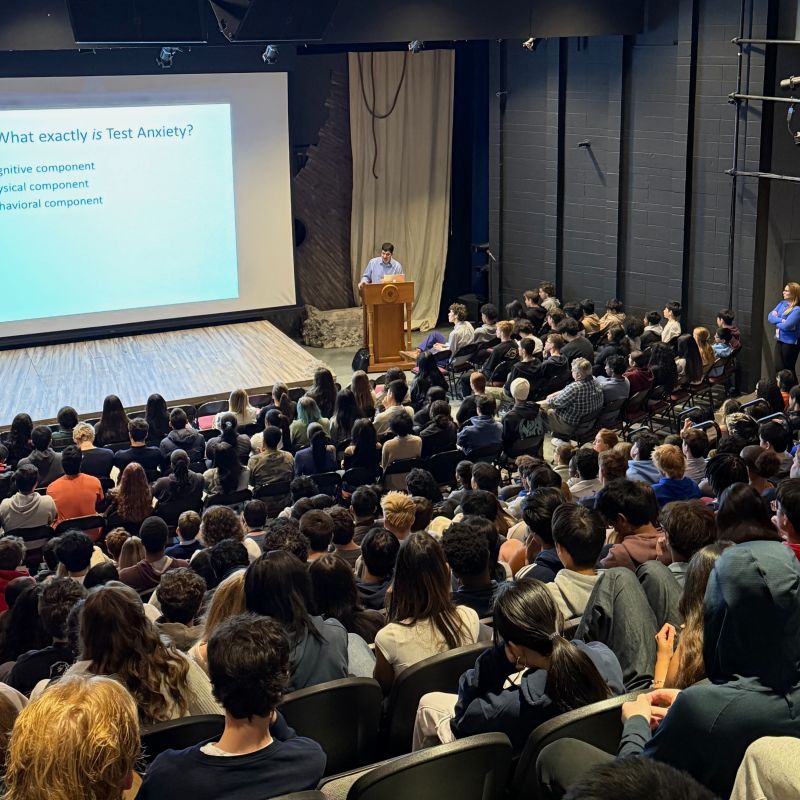
On November 19, 2025, the Upper School had the opportunity to hear a presentation on test anxiety by Dr. Ben Lovett. In his talk, Dr. Lovett used statistics and research to explain the science behind test anxiety, its potential causes, and potential strategies to help students improve their performance.
As a Professor of Psychology and Education at Columbia Teachers College, Dr. Lovett has spent years researching test anxiety in students across age divisions and has presented his findings to multiple middle and high schools across the nation. His expertise lies in special education and on the effects of testing accommodations, which have helped shape test-taking policies nationwide.
In an academically rigorous community like PDS, it is no surprise that assessments can serve as a major source of stress for many students. Upper School Dean of Students Michelle Simonds notes that, “We receive a lot of feedback from students in the Upper School that test taking is anxiety producing.” From morning check-ins with advisors, to frantic emails from parents, to overheard conversations in the halls, it is clear that students across grade levels experience varying degrees of anxiety surrounding test taking. Thus, Sra. Simonds hopes that “Hearing from somebody who’s an expert with [Dr. Lovett’s] level of expertise will open students’ eyes to a broader understanding of the problem.”
The information that Dr. Lovett shared helps set a foundation for minimizing test anxiety at PDS. He explained that because up to 40% of the population experiences test anxiety, it is not classified as a mental disorder in the DSM-5—a handbook published by the American Psychiatric Association for diagnosing mental disorders. He also emphasized that there is no direct correlation between test anxiety and test performance: poor performance typically results from reactions to test anxiety as opposed to the anxiety itself. This helps destigmatize test anxiety, making it easier for students to seek support when they are struggling instead of remaining silent because of shame or embarrassment.
While test anxiety remains a major challenge for students at PDS, Dr. Lovett’s presentation marks an important step towards helping combat the issue. As the school continues to explore ways to support the student population, his research-based insights may help inform how PDS should approach assessments and student well-being.